A Life Remembered: The Story of Marine Bobby Williams Jr.

DON COUNTS

Correspondent

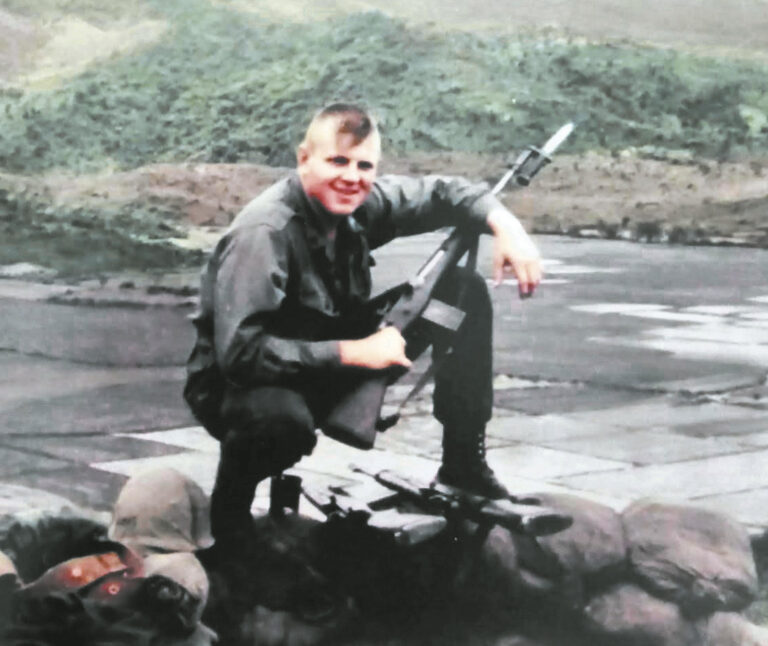
Inside the Warrior Exhibit in Fayetteville, memories live on, etched not only in displays and artifacts, but in the voices of those who remember. On this day, those voices belonged to two sisters, Linda Williams and Brenda Roles, who came to share the story of their brother, Marine Corporal Bobby Williams Jr., a young man whose life was cut short in Vietnam, but whose impact continues to echo through generations.

Bobby Williams Jr. was wounded on February 23, 1966, and passed away three days later aboard the USS Repose. In a letter home, a doctor told the family that “there wasn’t a dry eye on the ship,” a refl ection of the kind of person Bobby was full of life, deeply loved, and impossible to forget.

Raised in Lincoln County, Bobby and his sisters grew up in the heart of Fayetteville, where their parents owned R.D. Williams Jewelry and Gifts. Life centered on the town square, family, and hard work. “We were raised on the square, basically,” Linda recalled.

Bobby stood out even then. He loved horses, carried a natural confidence, and had a deep sense of loyalty. He was the kind of young man who defended others without hesitation. When a smaller boy moved to town and became the target of bullies, Bobby stepped in, teaching him martial arts and giving him the confidence to stand up for himself. That friendship lasted a lifetime, even inspiring the young man to follow Bobby into the Marine Corps. “He was always taking care of the underdog,” Brenda said. “That was just who he was.”

Stories of Bobby’s youth paint the picture of someone both fearless and unforgettable. At the Lincoln County Fair, he entered a saddle race on a horse few believed could compete. While others wore full western gear, Bobby rode in blue jeans, bareback, without fanfare. “They laughed him onto the track,” Brenda remembered. “But he won the race.” His love for animals was just as strong. When one of his horses was injured, Bobby walked it miles to the veterinarian rather than risk causing it more pain. It was a small act that revealed a great deal about his character.

Bobby’s path led him to the Marine Corps, where he trained at Marine Corps Recruit Depot Parris Island and was later stationed at Camp Lejeune. He also served as part of the Marine Corps Honor Guard in Washington, D.C., where he stood watch over John F. Kennedy as the late president lay in state. Despite the prestige of that role, Bobby chose a different path. “He had too tender a heart for all the funerals,” Linda said. “He wanted to go to Vietnam.”

Even in the military, Bobby’s personality never dimmed. Fellow Marines remembered him as upbeat, always smiling, and able to lift the spirits of those around him.

One Marine later shared a story from the night before Bobby was wounded. As the men opened their rations, Bobby’s pack was empty. “Anybody else would have complained,” Brenda said. “But Bobby just said, ‘This must mean something monumental is going to happen tomorrow.’” It did.

Back home, the Williams family sensed something was wrong before the official word arrived. Their mother saw two Marines walking across the courthouse square and knew immediately. Three days later, the news was confi rmed. “You will never know what it’s like to raise a son and send him to war and know he’s not coming back,” their mother said a rare moment of raw emotion from a woman who seldom spoke harshly.

The loss forever changed the family. Yet, amidst the grief, the community of Lincoln County surrounded them with support, bringing food, offering comfort, and standing beside them in their darkest days.

Decades later, Bobby’s story continues to surface in unexpected ways. Former Marines, chance encounters, and even international friendships have carried his memory forward. One fellow service member recalled Bobby’s humor and boldness during a Mediterranean deployment, where the two famously returned to their ship aboard a sailboat an unconventional and unforgettable entrance that perfectly captured Bobby’s spirit. “He was a character,” Linda said with a smile. But more than that, he was a young man who loved God, his family, his community, his country, and the Marine Corps.

At the Warrior Exhibit, the sisters made it clear why they chose to share Bobby’s story. “We interview veterans,” Linda said, “but the ones who didn’t come back don’t have anyone to tell their story. That’s why we wanted to do this.”

Through their words, Bobby Williams Jr. is no longer just a name etched in memory. He is a brother, a son, a friend, a vibrant life remembered not only for how it ended, but for how it was lived. And in Fayetteville, his story endures.