BOMA to issue bond to finance a $2.35 million fire truck
The Fayetteville Board of Mayor and Alderman approved the issuance of a general obligation bond to provide funds to finance purchasing a fire truck at last week’s regular monthly meeting.
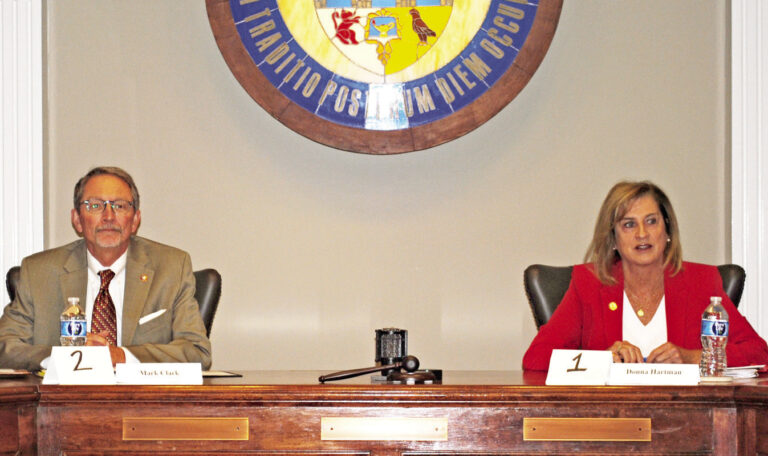
Mayor Donna Hartman said, the approval of the engagement letter through the law firm of Bass, Berry and Sims to secure the obligation bond “is not to exceed $2.35 million. There is a $12,000 fee for this bond.” She said See BOMA, Page 4A ^ purchasing the fire truck “was decided early on, but Chief Davy Bergman would like to get this on paper just making it official.” She said it has already gone through many discussions with BOMA approval.
“Do I have a motion?” Mayor Hartman asked. Alderman Jeff Alder, who sits on the finance committee, made the motion to approve issuing the bond. Alderman Tonya Allen seconded the motion.
“The $12,000 was included in our fees also,” said Alder.
“And to be clear, the board has already approved the purchase (of the fire truck),” said Alderman Joseph Faulkner. “This is purely for the bond.”
Voting to approve the issuance of general obligation bond to finance purchasing the $2.35 million fire truck were, Alderman Alder, Alderman Allen, Vice Mayor Jeff Bradford, Alderman Mike Keenan, Alderman Faulkner and Alderman Dorothy Small.
In giving his department report during the May 7 work session, Chief Bergman invited Vance Hamilton with the U.S. Department of Agriculture (USDA) Community Facilities loan program, “to come and answer any questions on the actual interest rate and the terms.”
The City applied for financing a tower truck with the U.S. Department of Agriculture (USDA) Community Facilities loan program when the BOMA approved and adopted Resolution 2023-23 on Nov. 14, 2023. The resolution states “it is necessary for the City of Fayetteville to raise a portion of the cost” by issuing bonds in the principal amount of $2.35 million pursuant to state laws.” At its May 2025 meeting, the BOMA approved Resolution 2025-09 authorizing the USDA loan. Hamilton was present during the May 8, 2025, work session when he said the percentage rate is “locked in at 3.5%.”
Last week, Hamilton said the USDA is the agency “that’s providing financing for the fire truck that y’all have ordered. I think it’s being built and Davy (Bergman) said it’ll be delivered maybe in fiscal year 2028. Bass, Berry and Sims is the bond council that will work with the City to issue the general obligation bond that will secure the note. There’s an engagement letter they have provided that they would like you to sign if you’re agreeable. They will begin drafting the resolutions that will be passed by the city council to do the bond issue that will secure the note.”
Hamilton said Bass, Berry and Sims does a lot of work with USDA. “They are very knowledgeable about the Tennessee state laws and the processing of issuing the bond and security,” he said. “I came this morning to answer any questions you might have about how the process works or any other questions you might have about the fire truck related to the financing and how the process will work.”
“Any chance it can go back to 20 years instead of 15 where it started at first?” asked Alderman Alder, referencing the term of the debt.
“Unfortunately, no,” Hamilton said. “I think 15 years is going to be the … what we have that’s what it’ll have to be. I think there was some confusion on my end at first. Originally, I thought we could do a 20-year term, but I was mistaken on that. So, it’s a 15-year term. The interest rate is 3.5%, which is quite a bit lower than what the current rate is. When we get down to the closing of a loan, if the interest rates are lower at that time — if they’re lower than 3.5% — you will get the benefit of the lower rate. Three and a half percent is the most it could be, but it could be less depending on what the rates are when it’s actually time to advance funds and you get the truck delivered. But it will be on a 15-year term, which is locked in.”
“I see in this agreement that it has a $12,000 fee,” said Mayor Hartman. “That’s correct,” Hamilton said. “We actually budgeted for $20,000 for legal expense in the budget. So you shouldn’t be out of pocket any of that. We included those fees because I knew there would be a cost to close the loan.”
Hamilton said Alexander Samber, with Bass, Barry and Sims, who does a lot of municipal lending, “will provide you the resolutions that will be passed by the city council when it’s time to do that. She will work closely with your local attorney to make sure all is done properly. She will file paperwork with the state comptroller when it comes time to close the loan because the state comptroller has to be notified when you take on new debt.”
In clarifying the $20,000 legal fee, Hamilton said, “If this comes under budget a little bit, we’ll just cancel out any loan money that we do not need. It’s easier to do that. We have a little bit of money left over. The final closing will just reduce the loan amount, whatever it comes to and we’ll just de-obligate that portion you don’t need. So you shouldn’t be out of pocket anything.”
Bergman said during the work session he was asking the board “to approve this and to move it to Tuesday night’s meeting for a vote.”
In May of 2025, Alderman Faulkner asked City Attorney John Hill, “How much would it cost if we decided to cancel this?”
Hill said to cancel “is a minimum of 10% of the purchase price, depending on where they are in the process. From what I gathered there was some questions about whether we might even be further into the process and that it could be 20% or more.”
Bergman said he hasn’t asked Hamilton that question, “because I really didn’t think it was an option at the moment, but if this board feels I need to ask that question then I can.”
During the May 8, 2025, work session, Bergman also said the fire truck on order “is not like a big shiny, new toy to us. The price of everything has increased tremendously in the fire service. If you look back, we purchased a 2022 KME (Kovatch Mobile Equipment Corp.) truck. It was like $625,000 and that was with equipment. Today that truck is over a $1 million. It’s very expensive to operate fire today.”