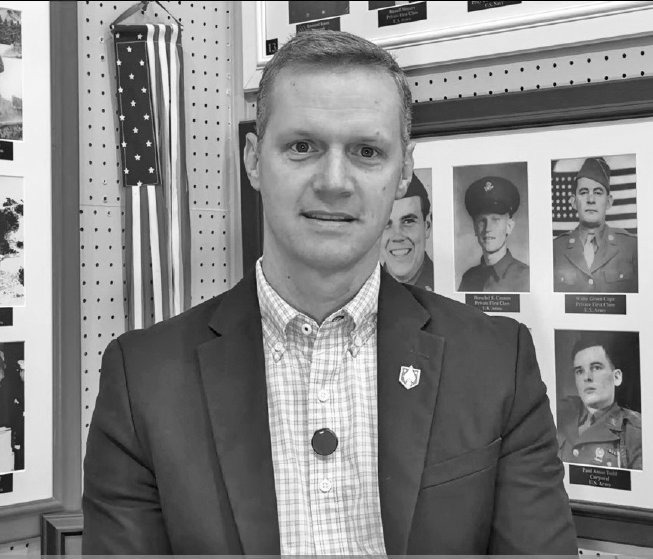
Duty, discipline, desire: Jeremy Thompson feels called to serve

Inside the Warrior Exhibit in Fayetteville Tennessee, the stories of service line the walls. On this day, one of those stories stood in front of us, not framed in glass, but living and breathing. Jeremy Thompson, a Lincoln County native with 22 years of service in the U.S. Army and Army National Guard, has built a life defined by duty, discipline, and an unwavering desire to help others.
Thompson was born in 1979 to blue-collar parents in Lincoln County. Service ran deep in his bloodline. His paternal grandfather served as a combat medic in World War II. On his mother’s side, his grandfather spent 26 years in the Army, including 36 months in combat between Korea and Vietnam.
But Thompson’s childhood was marked by tragedy. In 1984, his father was killed in a trucking accident while driving for the Lee Company in Fayetteville. Thompson was just five years old. His mother, widowed at 26 with two small boys, raised them with what Thompson describes as firm discipline and narrow “left and right limits.” “By the time I made it to basic training,” he said, “my drill sergeants really didn’t know what to do with me.” That early structure would become a cornerstone of a life built around service.
While still a senior at Lincoln County High School in 1998, Thompson began working with the Lincoln County Sheriff’s Department. Career assessments consistently pointed him toward public service like law enforcement, fire service, EMS, or the military. He didn’t choose just one. Thompson joined the volunteer fire department and became a state-certified firefighter while still in high school. He worked in corrections, volunteered in law enforcement capacities, served with Lincoln County EMS, and even gained experience with the Huntsville-Madison County Rescue Squad. “I’ve been blessed to do all of them in different capacities over time,” he said. Still, something tugged at him to do more.
In September 2000, he signed a contract with a National Guard Special Forces unit in Huntsville, Alabama, securing a position as an intelligence analyst supporting Green Berets with direct intelligence operations. He completed basic training, Airborne School at Fort Benning, and advanced intelligence training. He was at the Army Intelligence Training Center when the World Trade Centers were attacked on Sept. 11, 2001, which was a defining moment for a young soldier at the beginning of his military career.
Thompson quickly distinguished himself. He qualifi ed as an expert marksman out of basic training and maintained that distinction throughout his 22-year career. He later ranked among the top shooters in Alabama’s Governor’s Twenty competition which is an honor he accepted with pride but little fanfare. “I didn’t like the competition piece of it,” he said. “I never cared much for the spotlight.” His assignments were largely with the 20th Special Forces Group (Airborne) based in Alabama, with time spent at Fort Benning, Georgia. For two years, he and his family lived in a small apartment near Fort Benning while maintaining their home and farm in Lincoln County, driving back and forth nearly every weekend. “It came with a lot,” he said. “But it taught us a lot too.”
Thompson’s military service also included high-profi le public demonstrations which included rappelling from the rafters at a Huntsville Havoc hockey game during Military Appreciation Night which was a thrilling example of the specialized training he received. But some of his most meaningful moments came not during exercises or ceremonies, but in real-world crisis.
In 2014, while in uniform in South Huntsville, Thompson was involved in rescuing a person trapped inside a burning vehicle. His actions triggered an investigation and nomination for the Soldier’s Medal which was one of the Army’s highest awards for heroism not involving direct combat with an enemy. The approval process is notoriously rigorous. Many nominations never make it through. Thompson’s did. He was surprised with the award during a conference in Birmingham. “I didn’t know it was coming,” he said quietly.
His heroism also led to an appearance on “Hall of Heroes” with Tom Kennemer on Alabama Public Television, where service members recognized for valor share their stories. Yet Thompson downplays the accolades. For him, the driving force has always been internal. “I started developing this overwhelming desire to help people at a young age,” he said. “We all have an inherent responsibility to be good to each other.”
Even after completing his military career, Thompson’s service did not end. He now serves as executive director of the Special Operations of America, a 501(c) (19) nonprofit he co-founded with fellow special operations veterans. The organization advocates specifically for Tier One and Tier Two special operations service members, a group they felt lacked focused representation compared to larger veteran organizations like the American Legion and Veterans of Foreign Wars. What began as a volunteer effort has grown into a full-time operation with approximately 15 staff members nationwide. The organization works alongside the Department of Defense and State Department and has taken Thompson to the Middle East, Israel, and other regions in support of U.S. interests. Some details remain sensitive. But the mission is clear: continued service.
Through it all, Thompson credits his faith for guiding his steps and opening doors. That faith also shaped his family life. He and his wife, Lindsay, met in 1998 and married in 2004 after a six-year courtship with two of those years spent apart due to military training. Their first date included responding to a potential drowning call before dinner ever happened. Lindsay spent four hours in a patrol car while Thompson searched the river by boat. “If she wasn’t done already,” he laughed, “she would be tonight.” Instead, she stayed. Their son, Grady, born in 2007, recently turned 19 and was accepted to the University of Tennessee in Knoxville. He also serves on the volunteer fire department. Their daughter, Eden, born in 2012, is active in student council, cheer, and dance. Both have “very big hearts.”
In an unexpected turn, the couple recently entered the restaurant business, opening Revolutionary Tavern on the Fayetteville square. With no prior restaurant experience, they embraced entrepreneurship after Lindsay stepped away from her leadership role overseeing a $17 billion Patriot missile program at Redstone Arsenal. The restaurant’s original name concept, Lincoln’s Tavern, was changed due to trademark concerns. Instead, Revolutionary Tavern pays homage to Lincoln County’s namesake, General Benjamin Lincoln, who served under George Washington and accepted the British surrender at Yorktown. Portraits inside the restaurant feature QR codes that allow diners to learn about America’s founding figures while enjoying a meal. “We thought maybe we could teach a history lesson or two in the process,” Thompson said.
Thompson doesn’t claim to know exactly what the future holds. But he believes doors will continue to open. “If all the cards hit the table right,” he said, “we hope to run for Congress or serve in an elected position somewhere, if that’s what God has in store.” For a man who has spent his life answering calls, from fire tones to military orders, another call to service would simply be the next chapter. From a five-year-old boy who lost his father, to a Soldier’s Medal recipient, to nonprofit executive, husband, father and entrepreneur, Thompson Thompson’s life reflects a simple but powerful principle: Show up early. Wear the right uniform. Keep the right attitude. And be good to people along the way.