Student Utility Board learns about water and wastewater treatment
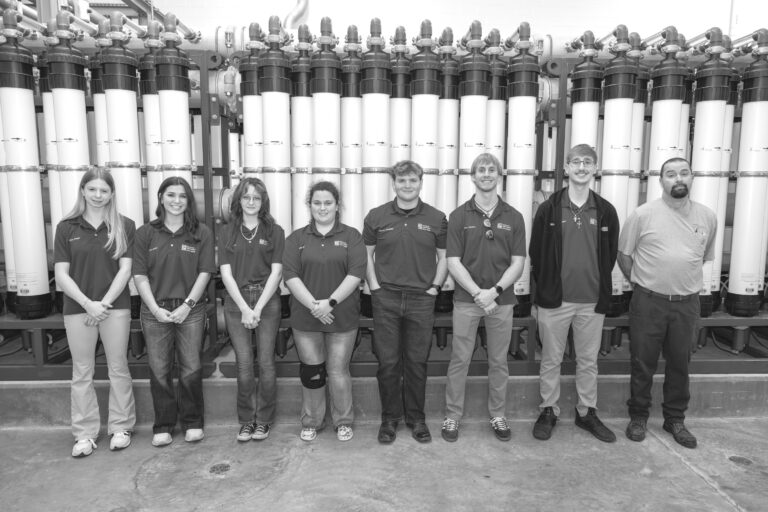
Fayetteville Public Utilities’ (FPU) Student Utility Board (SUB) recently met to tour the water treatment plant and learned about the process of turning water from the Elk River into clean, safe drinking water.
“Our advanced water system produces high-quality drinking water using state-of-the-art technology,” said FPU CEO/General Manager Britt Dye. “Students observe the entire process from start to finish, which includes the use of membrane filtration. This method results in drinking water that meets or exceeds all state and federal standards.”
Water Treatment Plant Supervisor Lee Williams gave an overview of the water department’s responsibilities and day-to-day activities. He explained the job requirements for operating a water treatment plant and described Tennessee’s four levels of operator certification and the training required to ensure employees are knowledgeable in the safe and proper operation and maintenance of the plant.
Williams and Assistant Water Treatment Plant Supervisor Wesley Roland led students on a tour of FPU’s Grade IV water treatment facility. Williams detailed the filtration process used to ensure the delivery of safe, quality drinking water to FPU customers. “Learning about the water treatment process showed me just how much goes into giving customers clean, drinkable water,” said SUB member Kali Groce After the toured, Williams explained the purpose of conducting routine water tests and reporting results to ensure the delivery of safe water to the community. FPU employees supervised students in the facilities’ laboratories as they evaluated water samples for pH levels, manganese, chlorine and fluoride. Students also performed a bacteriological water analysis to verify the absence of harmful bacteria in the supply.
In April, the board toured the wastewater treatment plant and discovered the biological processes used to treat wastewater.
“Wastewater treatment is an important and necessary process for the health and wellbeing of our community,” said Dye. “The students witness firsthand our commitment to maintaining quality of life by preserving the clean water supply, keeping the river’s ecosystem healthy and protecting our customers and community.”
Wastewater Treatment Plant Supervisor Dwight Jeans gave an overview of the plant and compared the biological treatment of wastewater to a giant industrial stomach, which mimics the digestion process by using microorganisms to break down organic waste.
Assistant Wastewater Treatment Plant Supervisor Eric Dale explained the method of collecting wastewater from customers, treating the used water and disinfecting it before releasing it back to the river. He said the process results in effluent water that meets all Environmental Protection Agency (EPA) and Tennessee Department of Environment and Conservation (TDEC) regulations and better quality water than the actual river water.
Students visited the lab where Dale demonstrated the daily tests performed to check water samples for bacteria such as E. coli. With the aid of a microscope, students observed the microorganisms responsible for breaking down the solids and cleaning the water.
Dale explained how customers can help the wastewater treatment plant run smoothly, stressing the importance of only flushing toilet paper. Flushable wipes, cleaning wipes and baby wipes might pass through the drain, but they can create backups and costly repairs in sewer lines and treatment plants. Dale described how fats, oils and grease can build up and clog pipes if poured down drains. He instructed students to dispose of these products by allowing them to cool, pouring them in disposable containers and placing them in the trash.
Lastly, Dale described the bio-solids removal process and explained how bio-solids are treated and recycled to create soil enhancement for agricultural use.